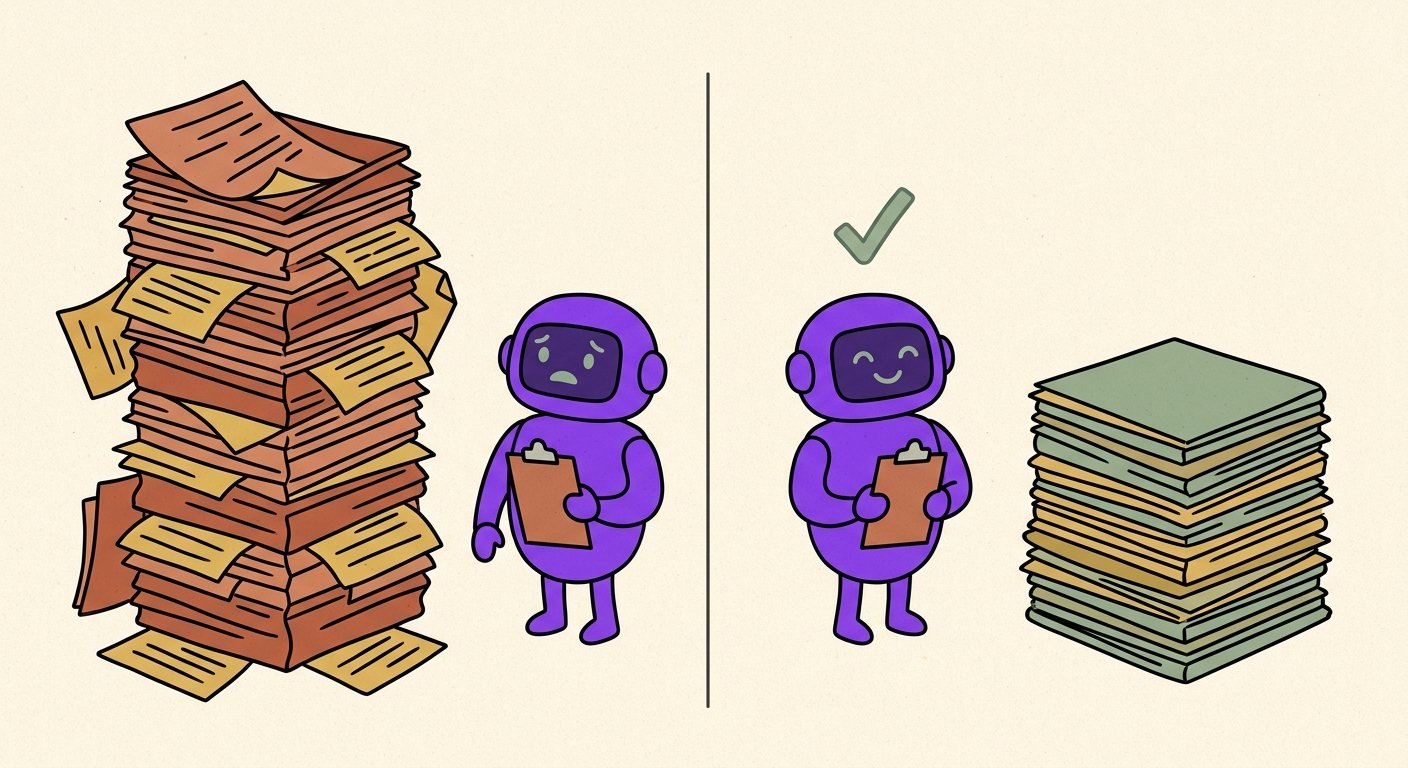
Have another AI audit your AI workflows. The 40% and 2x gains are real.
A developer asked Fable to optimize his Claude Code skills. Average result: 40% shorter and one skill 2x faster. Here is the pattern, the ROI, and the small habit that makes it work.
Have another AI audit your AI workflows. The 40% and 2x gains are real.
A few days ago, the developer svpino posted something I keep coming back to. He maintains a stack of skills for Claude Code. He uses those skills every day. He asked Fable, an AI model from a small lab, to read every skill and optimize them. Average result: 40% shorter. Everything still worked. Nothing got worse. One of the skills writes rows to a spreadsheet through an MCP server. Fable found a way to batch the writes in parallel, and that single skill now runs twice as fast.
The numbers are not the interesting part. The interesting part is that he did not write a line of code. He did not refactor a function. He delegated the refactor to a second AI and pointed it at the first AI's output. That is a different shape of work than most teams are doing today, and the ROI is hard to ignore.
What he actually did
The setup is small enough to copy. There is a folder of skill files. Each file is a prompt plus a few tool definitions. A model reads them. A second model rewrites them. The second model is not a generalist; it is tuned for code and skill optimization. The output is shorter, the behavior is the same, and one skill that previously did a serial write now does a parallel batch.
Forty percent shorter means less context window burned on every invocation. For a power user of Claude Code, that is real money, because the cost of an AI tool is mostly tokens, and tokens are mostly context, and context is mostly whatever you put in the skills. Cutting the skills by 40% cuts the per-call cost by a comparable amount. Twice as fast on a single skill is harder to put a dollar number on, but for any workflow you run more than ten times a day, it adds up to a workday you do not have to spend.
If you do the math the boring way, the savings on a single skill file might be a few cents per call. Multiply that by the number of times a small team hits the skill in a week, and the result is in the same range as a small contractor invoice. The point is not that one optimization pays the rent. The point is that the loop is now cheap enough to run whenever you want.
Why this is bigger than one developer's setup
Most teams treat their AI workflows like source code: written once, frozen, and only touched when something breaks. That worked when the cost of a human refactor was higher than the savings. It is the wrong default now, because the cost of an AI refactor has collapsed.
A working pattern looks like this. You build a prompt. You ship it. A month later, you ask a second model to read the prompt and the surrounding tooling, then propose a tighter version. You diff the two. You run a small test set against both. If the new one passes and is meaningfully shorter, you swap it in. If not, you keep the old one. The whole loop takes an afternoon. The savings compound.
For an SMB running AI on the sales side, this is the cheapest productivity gain available right now. The prompts that summarize customer calls, draft follow-ups, score leads, and triage support tickets are mostly written by the same person who set up the tool, who is not a prompt engineer, who has not had time to go back and tighten the wording. The cost of leaving them bloated is silent. It is also large. A prompt that is 40% longer than it needs to be is paying 40% more in API bills, taking 40% longer to return, and producing output that is harder for the next prompt in the chain to read. The waste is structural.
Where this gets weird
There is a version of this story that does not hold up. If your AI workflow is a black box, with no tests, no logs, and no way to replay a bad answer, then asking a different model to optimize it is asking for trouble. You will get a tighter prompt that does something subtly different, and you will not know until a customer notices.
The teams that get the most out of this pattern are the ones who treat their prompts and skill files like the rest of their stack. Versioned. Reviewed. Tested against a small fixed set of inputs. The optimization loop is only safe when you can tell whether the rewrite broke anything. If you cannot, the 40% gain evaporates the first time a sales rep forwards you a hallucinated price quote.
There is also a ceiling. Fable is good at cutting fat from prompts, but it does not redesign workflows. It will not notice that two of your skills are doing the same job and one of them should be deleted. It will not catch that your lead-scoring prompt is rewarding the wrong signal because the criteria you wrote down in week one were never right to begin with. Those are human jobs, and they are still the highest-leverage places to spend an hour.
A practical way to run your own audit
If you want to try this in the next week, here is the smallest version of the loop that I have seen work.
Pick one prompt you use at least five times a day. Find a second model that is good at editing and is not the same model that wrote the prompt originally. Hand it the prompt, a handful of example inputs, and a description of the output you want. Ask for a tighter version. Diff the two. Run your example inputs through both. If the new one matches or beats the old one on the cases you care about, swap it in. If it is worse on any case, throw it away and try again.
That is the whole thing. It is not a platform, it is not a framework, it is not a service you need to buy. It is a habit.
The bigger move, the one that pays off over a quarter, is to do this on a schedule. Every Friday, pull the most-used prompts in your stack, run the audit, and ship the wins. Most weeks nothing will change. Some weeks you will find a prompt that has been quietly burning two cents per call for six months. The first time you catch one of those, the loop pays for the year.
What this is really about
The interesting question is not whether AI can optimize AI. The interesting question is whether your team is set up to benefit when it does. The teams that get the most out of a tool like Fable are the ones who already had a habit of cleaning up after themselves: who versioned their prompts, who kept small test sets, who had a workflow for swapping in a better version of something without breaking everything else. The optimization is the easy part. The infrastructure around it is the actual work.
If you are starting from a clean sheet, build that infrastructure first. The optimization will arrive. It always does, and it arrives faster than you expect. When it does, you want to be the team that can absorb a 40% improvement on a Friday afternoon and ship it before lunch.

Conversational Patient Intake in Real Clinics: What The Lancet Study Teaches Practice Operators

Vertical AI is moving from dashboards to doing the work: what an AI property manager shows operators