The Mac-Mini-in-the-Cloud Pattern That Just Killed the $80k iOS Build
Pieter Levels shipped a native iOS app last weekend by prompting Claude Code from a Mac Mini in a cloud datacenter. No Swift written, no Xcode opened. Here is what changes for SMBs sitting on a $60k agency quote.
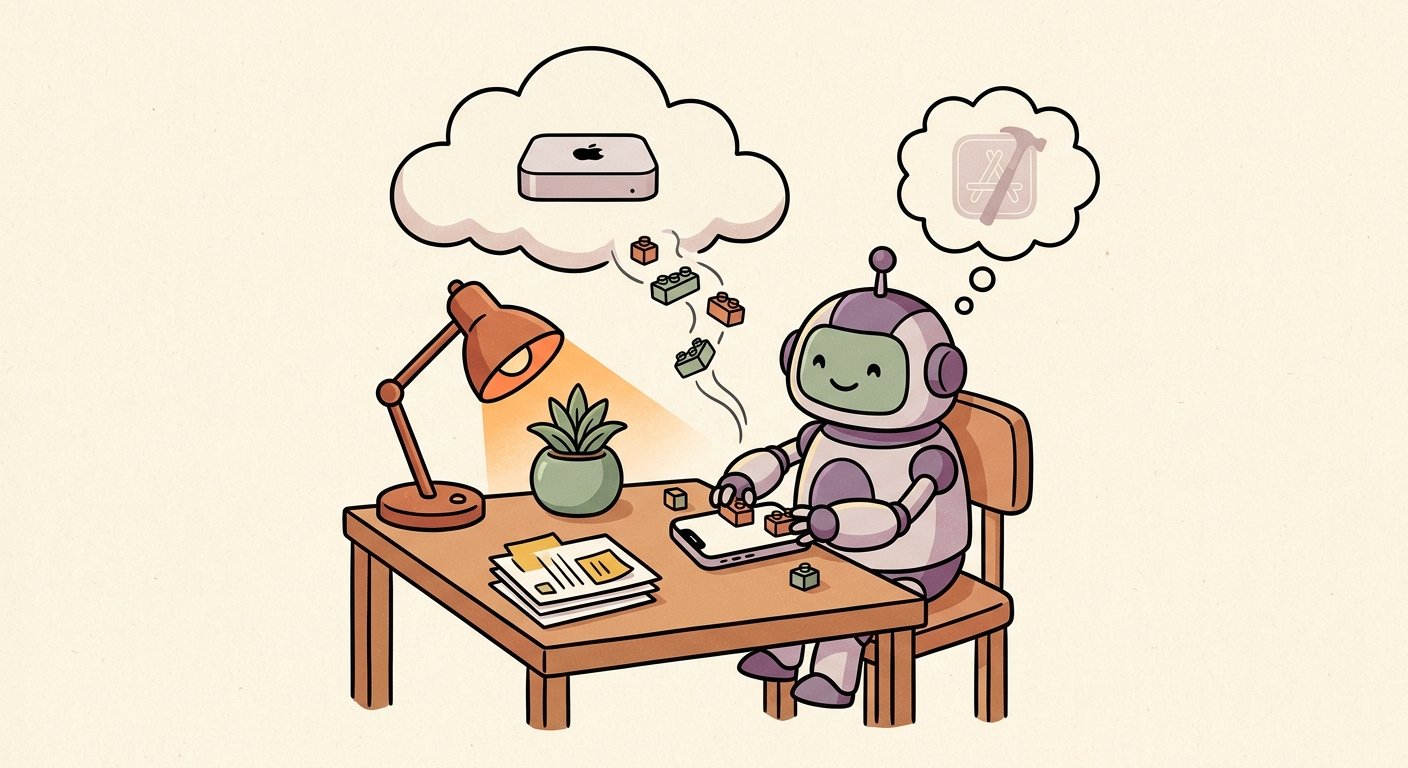
Last weekend, the indie hacker Pieter Levels shipped an iOS app without writing a line of Swift. Not a prototype — a real one, with a profile page, native UI elements, and an API connection to the web app he has been running for years. He did it by prompting Claude Code, which runs on the same server as his website, and watching it build the /api route, scaffold the SwiftUI views, and ping him when the build succeeded. He never opened Xcode. The build happened on a headless Mac Mini in a cloud datacenter somewhere.
It is the kind of post that looks like a one-off demo and is actually a structural shift. The cost of shipping a small native mobile app for an SMB has just dropped by an order of magnitude, and almost nobody in the SMB tooling world has noticed yet.
What the Levels Stack Actually Did
For readers outside the indie-hacker bubble, a quick decode of the tweet.
Claude Code is Anthropic's agent-style CLI for working inside a real software repository. It reads code, writes code, runs shell commands, edits files, and iterates. Levels wired it onto the same Hetzner VPS that already hosts his website. When he prompts Claude Code from his phone, the agent runs on the server where the data already lives.
The interesting move was the second hop. The agent did not stop at the website. It SSH'd into a Mac Mini rented from Macincloud, opened Xcode there, scaffolded a SwiftUI project, compiled it, took a screenshot, and sent Levels a link to inspect the result. Native Swift, native UI elements, no human in the loop. The headless Mac Mini is a small ARM machine in someone else's datacenter that compiles Xcode projects on demand. It costs about thirty cents an hour.
That whole pipeline — prompt, agent loop, build server, screenshot — ran without Levels logging in to anything. He just talked to it.
The Old Math for a Small Native App
The traditional route for an SMB that wanted a small native iOS app — say, a customer portal, a field-service tool, a bookable widget — looked like this.
You hire an agency. The agency quotes between thirty thousand and eighty thousand dollars for the first version. You wait four to six months. The agency writes five thousand to fifteen thousand lines of Swift, plus the API layer that talks to your existing backend, plus the auth, plus the screens, plus the App Store submission. You discover, three months in, that one of the five screens you thought was included actually requires a change order. The build goes live. Maintenance is another two to five thousand dollars per month.
That price point was correct for what it was. Building a native SwiftUI app from scratch with no code is a real engineering job. A senior iOS contractor charges one hundred fifty to two hundred fifty dollars per hour. The work takes two hundred to four hundred hours. The math is what it is.
The New Math for the Same App
Levels' stack changes the bottom three lines of that quote.
The agent does not get paid per hour. You pay per token, and the tokens are coming down. A focused prompt that scaffolds a SwiftUI profile page, wires it to an existing /api route, and submits the build to TestFlight runs in a few minutes of model time. At retail rates on Claude Sonnet or comparable models, that is somewhere between fifty cents and three dollars of inference per page. The whole app — five pages, an auth layer, the API bridge — is a long afternoon of agent runs. The cost is under twenty dollars in inference, plus the Mac Mini time at thirty cents an hour for the build minutes.
The savings are not in the inference line. The savings are in the parts of the build that no longer need a human at all: the boilerplate, the Xcode project file, the API plumbing, the navigation shell. The agent does those in seconds. The senior engineer used to bill for them at two hundred an hour.
What is left for the human is the product judgment. Which screens matter, what the user flow looks like, which fields belong on which page. That is the work a founder is uniquely positioned to do, because it is the work that does not transfer cleanly to a contractor.
Why This Pattern Lands for SMBs First
The pattern is not "Claude Code replaces iOS engineers." A serious native app with deep system integration, custom animations, accessibility, offline support, and a thousand-edge-case spec still needs a senior human. What the pattern replaces is the small app. The internal tool. The customer-facing portal with five screens. The bookable widget. The field-service tracker.
For an SMB, that is most of what an iOS app has ever been. The big-enterprise iOS projects are still being built the old way, and probably will be for another eighteen months. The small-business iOS projects — the things that show up in the App Store charts under "small business" and "utilities" — are now buildable by a founder who can write a clear prompt and a clear product spec.
Three properties of the stack make the SMB case land first:
- The build server is rented, not owned. A Mac Mini in a datacenter costs thirty cents an hour. A serious iOS shop has a Mac Pro at six to ten thousand dollars. The SMB does not need to own the hardware.
- The agent lives where the data lives. When the same server hosts the website and the agent, the /api routes are local. There is no separate staging environment, no API key management, no auth handshake. The agent reads the existing code, calls the existing endpoints, and ships the changes to the same repo.
- The feedback loop is fast. The agent builds, screenshots, and pings. The founder reviews the screenshot on the phone, prompts a fix, and watches the next build. There is no PR review meeting. There is no sprint planning. There is the loop.
What This Means for Your SMB Stack
If you have a business that has been waiting for a small iOS app because the build quote was too steep, this is the quarter to revisit it. The math is different now.
The candidates are the apps you keep describing in standups and never get budget for: the customer-portal version of the spreadsheet your reps use; the field-tracker version of the paper form your techs fill out; the bookable widget for the consultation your sales team closes by phone; the loyalty card for the cafe you opened last year. None of those need a sixty-thousand-dollar agency. All of them need a clear spec and a focused week of prompt-driven agent work.
The other shift is the deployment shape. A Mac Mini in a cloud datacenter is not a consumer product. It is a piece of rented infrastructure. The SMB does not buy it, install it, or maintain it. The agent uses it for the duration of a build. When the build is done, the headless Mac Mini goes back into the pool. The SMB's monthly iOS build cost is the sum of the agent time and the build minutes, both of which are line items on someone else's invoice.
That is a fundamentally different cost structure from "we have a ninety-thousand-dollar retainer with an agency." It is the difference between owning a fleet of cars and renting one when you need to move a couch.
How Nextlify Fits Into This
Nextlify does not build custom iOS apps, and we do not sell agent frameworks. We publish a catalog of ready-made AI assistants built for specific industries — 105 apps across roughly 95 verticals — each one handling the inbound side of a business: answering questions, capturing details, and booking appointments.
The connection to the Levels pattern is the underlying shift, not the toolchain. The cost of turning a clear idea into working software has collapsed. That is the same reason an off-the-shelf assistant tuned to one industry now beats both a generic chatbot and a bespoke build for most small businesses: the specificity that used to require a custom project is now something you can just pick off a shelf.
If you have been holding off on a small native app because the quote was too high, this is the quarter to revisit it. The Mac-Mini-in-the-cloud pattern is real. The cost floor has moved. Most of the older "we will build it next year" decisions are wrong now.
Talk to us about Nextlify to see the AI assistant built for your industry.

Conversational Patient Intake in Real Clinics: What The Lancet Study Teaches Practice Operators

Vertical AI is moving from dashboards to doing the work: what an AI property manager shows operators